 blog
blog
Best Trading Card App for Vendors: 2026 Guide
Table of Contents
- Key Features Every Trading Card App Needs
- How Sports Card Scanner Apps Work: Image Recognition vs. Barcode
- Real-Time Card Pricing App: Live Market Value and Price Alerts
- Trading Card Inventory Management: Tracking, Analytics, and Multi-User Attribution
- Graded vs. Raw Cards: Valuation and Set Registry Support
- Data Privacy, Security, and Tax Reporting for Your Collection
- How to Choose the Right Trading Card App for Your Booth
- Frequently Asked Questions
Last Updated: September 21, 2026
Key Features Every Trading Card App Needs
The best trading card app for a working vendor does three things well: catalogs inventory fast, prices cards against live market data, and reports what you made at the end of a show.
At Card Show Vendor, we built our platform around those three jobs because they decide whether a weekend booth is profitable.
Here is what separates a tool you can run a business on from a hobby tracker:
- Fast intake: scan or type a card in seconds, not minutes
- Live market value: pricing that updates as the market moves, not a static list you refresh by hand
- Inventory tracking: every card accounted for across every event
- Profit and loss reporting: real numbers on what sold and what it cost you
- Multi-user support: more than one person working the same inventory without collisions
- Offline tolerance: the booth Wi-Fi will fail, and the app cannot fail with it
That last point is where many trading card apps quietly break. A packed hall with hundreds of phones competing for one access point is hostile to any tool that assumes a stable connection.
How Sports Card Scanner Apps Work: Image Recognition vs. Barcode
A sports card scanner app identifies a card either by reading its printed barcode or by analyzing the card image itself. Barcode scanning is faster and more accurate when a barcode exists; image recognition covers the older and unlicensed cards that never had one.
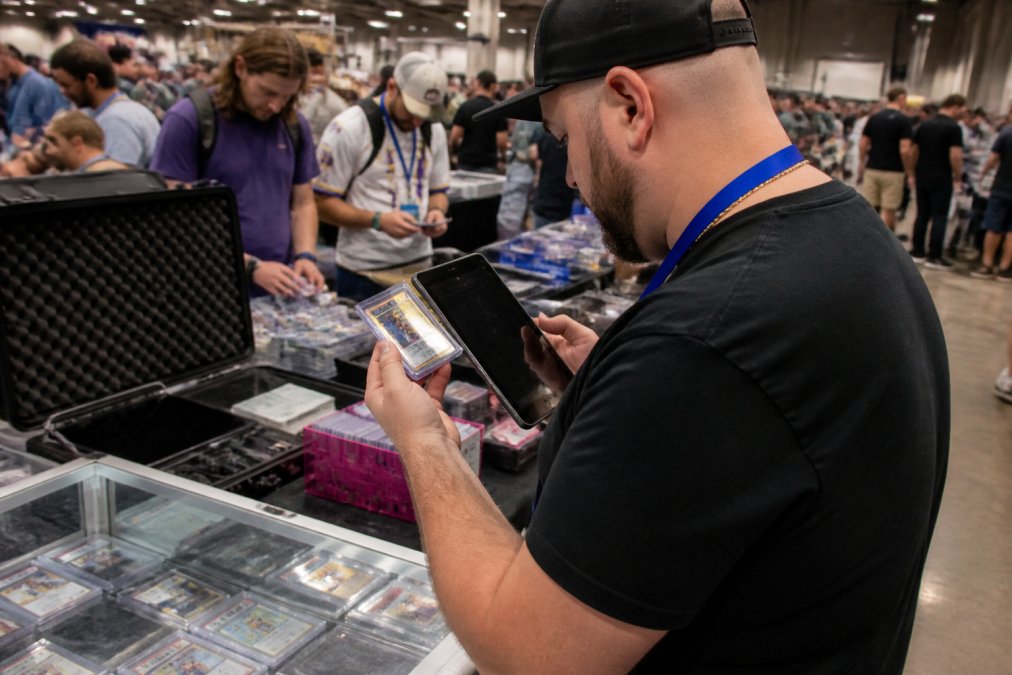
Barcode scanning pulls a clean identifier and matches it against a card database, but coverage is the problem: modern cards from major manufacturers carry barcodes, while a 1987 sports card or a hand-collated trading card game lot does not.
Image recognition reads the card the way your eye does: name, set, number, artwork. Under the hood, most apps run two stages. First, optical character recognition (OCR) extracts the printed text, player name, set name, card number, and any parallel or insert designation. Second, an image-matching model compares the card's artwork and layout against a reference library to confirm the set and variation. OCR fails when the text is small, curved, or low-contrast; image matching fails when glare, sleeves, or a different parallel produce a near-miss. National Institute of Standards and Technology guidance on biometric and image matching systems explains why matching accuracy depends so heavily on input quality, and the same principle applies to card scanning.
That is why lighting and condition matter more than most vendors expect: a card under a warm booth lamp reads differently than under neutral daylight, a penny sleeve adds a reflective layer, and soft corners or surface wear can defeat a model trained on clean reference scans.
No public, standardized benchmark exists for card-scanning accuracy across apps, so test with your own inventory rather than trust a marketing claim. A reasonable self-test:
- Pick 20 cards that represent your actual mix, modern barcoded, vintage raw, graded slabs, and at least one parallel.
- Scan each card three times: once under booth lighting, once under daylight, once through a sleeve.
- Record how often the app returns the correct set, number, and variation on the first attempt.
- Repeat with a second app and compare hit rates.
Most practitioners find barcode scanning hits near-perfect accuracy when a code is present, while image recognition on vintage raw cards lands well below that. The exact number depends on your card mix, which is why the self-test matters more than any spec sheet.
| Method | Best For | Speed | Accuracy Risk |
|---|---|---|---|
| Barcode scan | Modern cards with printed codes | Fastest | Low when code present |
| Image recognition | Vintage, unlicensed, raw lots | Moderate | Higher in poor light, sleeves, and worn cards |
| Manual entry | Graded slabs, oddities, parallels | Slowest | Lowest |
Real-Time Card Pricing App: Live Market Value and Price Alerts
A real-time card pricing app pulls current market value from sales data rather than a fixed price list, so the number on your screen reflects what buyers are actually paying this week. Market value on collectibles moves: a player gets traded, a set goes out of print, a new expansion shifts demand. If your prices are set the night before a show and never touched, you are either leaving money on the table or scaring buyers off.
What to look for in live pricing:
- Recent sales data, not asking prices alone
- Price history so you can see whether a spike is real or noise
- Price alerts that flag when a card crosses a threshold you set
- Market trends across a set or category, not just single cards
Trading Card Inventory Management: Tracking, Analytics, and Multi-User Attribution
Multi-user attribution also tells you who on your team is strongest at which category, a staffing decision you cannot make from a single combined sales total.
Graded vs. Raw Cards: Valuation and Set Registry Support
- Store the cert number and grade tier for every slab, and price against that tier.
- Track raw cards by condition band, and re-band them when you get better at grading your own market.
- Watch population counts on any card where the price looks unusually high.
- Run a set registry for any set you are actively completing or breaking.
- Export a dated inventory with values at least quarterly, and keep the exports, they are your insurance and tax paper trail.
IRS guidance on business income and recordkeeping is clear that income from selling collectibles is reportable and that you need records to support your deductions. The same records that satisfy a tax preparer usually satisfy an insurer. Build them once, in the app, and keep them current.
Data Privacy, Security, and Tax Reporting for Your Collection
Your collection data is a business record: know where it lives, who can see it, and what happens to it if you stop paying.
Three questions to ask any provider before you commit:
- Who owns the data? You should be able to export your full inventory, price history, and transaction records at any time.
- How is it secured? Look for encryption in transit and at rest, and role-based access so a booth helper cannot see your margins.
- What is the retention policy? If you cancel, your records should leave with you.
How to Choose the Right Trading Card App for Your Booth
Choose based on how you actually work a show, not the longest feature list. The right trading card app for a two-person weekend operation is not the same as the right one for a six-person team running a full season.
Work through these in order:
- Count your users. If more than one person sells, you need multi-user support with attribution. Paying per seat for people who never touch the app is wasted money.
- Check your card mix. Mostly modern barcoded cards? Scanner speed matters most. Heavy vintage or trading card games? Image recognition and manual entry quality matter more.
- Test offline behavior. Simulate a dead connection and try to complete a sale.
- Confirm data export. Export your inventory before you commit, not after.
- Match the pricing model to your calendar. If you vend seasonally, a tool priced for year-round use may not fit.
| Your Situation | What Matters Most | What to Deprioritize |
|---|---|---|
| Solo vendor, weekend shows | Speed and simplicity | Team features |
| Two to six person team | Multi-user attribution | Solo-only workflows |
| Vintage and raw heavy | Image recognition, condition tracking | Barcode speed |
| Graded card specialist | Grade-tier valuation, set registry | Raw condition bands |
| Seasonal vending | Event-scoped inventory | Always-on subscriptions |
Frequently Asked Questions
What is the best app to use for trading cards?
The best trading card app depends on your needs. For vendors, look for one with real-time pricing, inventory tracking, and multi-user support. A trading card app like Card Show Vendor offers event-scoped inventory, live pricing updates, and profit and loss reporting, all under one subscription for up to six users. It works on web and iPad, making it practical for booth operations.
Is there an app that tells you how much your trading cards are worth?
Yes, many trading card apps provide market value estimates. A real-time card pricing app pulls data from recent sales and market trends to show current values. Some also track price history and send price alerts. For accurate valuations, ensure the app supports both raw cards and graded cards, and updates pricing frequently.
What is a good free app for scanning trading cards?
Several free apps offer basic scanning and identification, but they often lack advanced features like inventory management or real-time pricing. For serious vendors, a paid trading card app with a subscription is more reliable and includes multi-user support, profit tracking, and data synchronization. Free options may limit scans or not include sports card scanner app functionality.
How do trading card scanner apps work?
Trading card scanner apps use your device's camera and image recognition to identify cards. Some also support barcode scanning for graded slabs. Once identified, the app matches the card to its database and retrieves market value, price history, and other details. This speeds up cataloging and inventory tracking, especially at busy card shows.
Running a booth on spreadsheets works until it does not, and the failure usually shows up mid-show when you cannot tell what sold or what it was worth. Card Show Vendor gives you event-scoped inventory management, live pricing updates, and multi-user support with attribution, all on one subscription covering up to six users on web and iPad. Get started with Card Show Vendor and walk into your next show knowing exactly what is in the boxes and what it is worth.