
 listicle
Best Ways to Manage Booth Sales: 7 Proven Tactics
Table of Contents
- Quick Comparison: Top Tools for Managing Booth Sales
- 1. Plan Your Show Strategy Before You Pack a Single Card
- 2. Trading Card Inventory Management That Prevents Double-Selling
- 3. How to Increase Trade Show Booth Traffic Without Gimmicks
- 4. Staff Your Booth for Speed and Sales Conversion
- 5. Best Practices for Card Show Vendors: Lead Capture and Follow-Up
- 6. Post-Show CRM Integration: Where Most Vendors Lose Money
- 7. Budget-Friendly Tactics and Handling Slow Periods
- Frequently Asked Questions
Last Updated: October 2, 2026
Quick Comparison: Top Tools for Managing Booth Sales
Managing booth sales comes down to three things: knowing your inventory, tracking what sells, and following up fast. The right tool depends on whether you run a solo table or a six-person crew.
| Tool | Best For | Standout Feature | Pricing Model |
|---|---|---|---|
| Card Show Vendor | Card show vendors running 1-6 person booths | Event-scoped inventory with live pricing | Single subscription, up to six users |
| Microsoft Dynamics 365 Sales | Mid-to-large enterprises | Deep Microsoft ecosystem integration | Custom quote |
| Pipedrive | Small teams wanting a visual pipeline | Drag-and-drop deal tracking | Custom quote |
| MapD Events | Event organizers, not individual vendors | Interactive floor plan management | Custom quote |
| PocketPrice | Solo vendors testing the waters | Image-based item identification | Custom quote |
| Booth Manager | High-volume sports card dealers | Live pricing updates for event sales | Custom quote |
1. Plan Your Show Strategy Before You Pack a Single Card
The vendors who make money at shows aren't the ones with the most inventory. They're the ones who decided what "a good show" looks like before they loaded the van.
Set Measurable Goals and KPIs for Every Event
Vague goals produce vague results. Give every show a number to beat.
- Revenue target: What dollar amount covers your table fee, travel, and time?
- Units sold: A simple count that tells you if traffic converted.
- Average sale value: Are you moving bulk or chasing singles?
- Lead count: How many contacts did you capture for follow-up?
- Margin per category: Which product lines actually paid off?
2. Trading Card Inventory Management That Prevents Double-Selling
Double-selling costs vendors the most, and it almost always happens the same way: a card is listed online, sells there, then sells again from your booth because nobody updated the binder.
Live Pricing Updates and Event-Scoped Tracking
Card prices move. A reprint announcement or tournament result can shift a single's value mid-weekend, and pricing off a Thursday list means leaving money on the table by Saturday.
3. How to Increase Trade Show Booth Traffic Without Gimmicks
The best way to increase trade show booth traffic is to give people a reason to stop that has nothing to do with a spinning wheel or free sticker. Card buyers stop for cards they want to see, priced fairly, from someone who knows the product.
The Two-Second Scan: What Attendees Actually See
An attendee walking the aisle runs a fast visual sort, looking for three signals:
- Category signal. Can I tell in one glance what this booth sells? A case of graded slabs, a wall of sealed product, or a row of bulk boxes answers that instantly. A mixed table with no dominant category reads as "maybe nothing for me" and gets skipped.
- Price signal. Are prices visible without asking? Unmarked binders and "ask for price" signs create friction at the moment of decision. A visible price tag converts a scan into a stop.
- Social signal. Is anyone already at the booth? One browsing customer draws better than an empty table, which is why the first stop of the day matters disproportionately, one person browsing pulls the next two or three.
Concrete Tactics That Exploit the Scan
Here's what pulls people in, mapped to that scan behavior:
- Show your best material at eye level. Graded slabs and key singles belong where they're visible from the aisle, not in a knee-height case. Someone scanning from ten feet away should identify your top three cards without leaning in.
- Price clearly and consistently. Unmarked binders get skipped. If a card is negotiable, mark it with a range or "make an offer" tag, blank reads as "expensive" or "not for sale."
- Create a browsing zone. One section for bulk, one for singles, one for sealed product. A defined bulk box gives a low-commitment entry point for attendees not ready to ask about a $400 single.
- Talk about the cards, not the sale. "This is the first-year print run" opens a conversation; "let me know if you want a price" closes it.
- Use one anchor piece to stop the aisle. A grail, rare parallel, or signed slab at the front corner gives the scanning attendee a reason to break stride. It doesn't have to be for sale; it has to be worth a look.
What Doesn't Work (and Why Vendors Keep Doing It)
Gimmicks, spin-to-win wheels, free stickers, raffles, pull a different crowd than the one that buys. They generate a burst of foot traffic that converts poorly and train attendees to associate your booth with the giveaway rather than the inventory. Vendors who consistently do well have booths that look like a smaller, better-organized version of what the attendee came to buy.
4. Staff Your Booth for Speed and Sales Conversion
Booth sales conversion is a staffing problem before it's a sales problem. If one person handles pricing, transactions, and questions while a line forms, you lose sales to impatience.
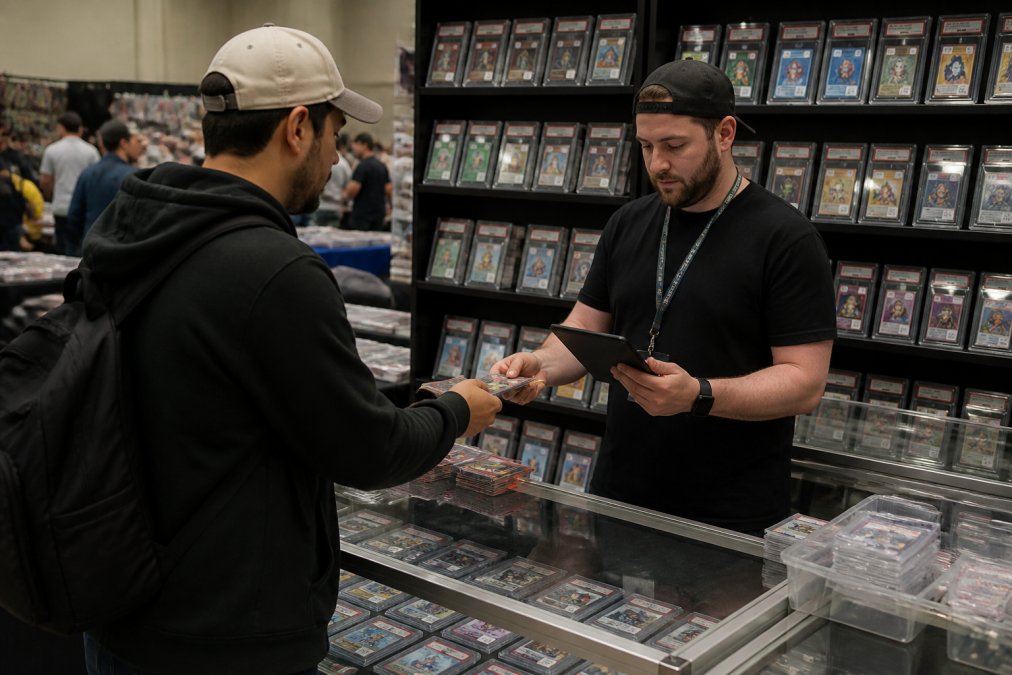
Train your team on three things before the doors open:
- Where prices live and how to update them
- How to process a sale in the app
- What to say when a card isn't priced
5. Best Practices for Card Show Vendors: Lead Capture and Follow-Up
Best practices for card show vendors start with one habit: capture the lead before the buyer walks away. Most card show sales are one-time transactions, but the buyer who wanted your Charizard and didn't have the cash is a sale next month if you have their contact.
Capture Light, Capture Tagged
Keep lead capture light: a name, an email or phone number, and a one-line note about what they wanted. Anything longer and people won't do it.
- Which show it came from. Without this, you can't measure whether a show was worth returning to, and you can't segment follow-up by event.
- What they wanted. A specific card, a category ("vintage basketball"), or a budget range. This is what makes the follow-up message feel personal instead of generic.
The 48-Hour Window and Why It Matters
Follow up within 48 hours. A short message referencing what they wanted converts far better than a generic "thanks for stopping by," because the buyer's intent is still warm, they were at the show, looking at your inventory, with a specific want. Two days later, that context still reads as helpful rather than marketing.
A workable follow-up template:
- Subject or first line: reference the show and the card. "You were looking at the PSA 9 Umbreon at [show name]" beats "Following up from the show."
- Body: one or two sentences. Confirm you still have it (or have something comparable), give the price, and offer a next step, a photo, a hold, a shipping quote.
- Close: a single clear ask. "Want me to send a photo?" is easier to answer than "Let me know if you're interested."
Where the Pipeline Actually Breaks
The money you lose at a card show usually isn't lost at the show, it's lost in the week after, when leads sit in a notebook, phone note, or text thread and never make it into anything you'll use. The failure mode is consistent: the vendor captures twenty leads, follows up with the five they remember, and the other fifteen go cold.
From Lead to Repeat Buyer
The tag turns a one-time transaction into a repeat relationship. A buyer who wanted a card you didn't have is a warm lead for the next show, and if your lead data is tagged by show and want, you can reach out before the next event with a specific "I'll have one of these at [show name]" message.
6. Post-Show CRM Integration: Where Most Vendors Lose Money
Post-show CRM integration means booth leads flow into the same system you use to track sales, so follow-up happens automatically instead of depending on memory. Vendors who skip this step re-sell to the same people and wonder why growth stalls.
7. Budget-Friendly Tactics and Handling Slow Periods
Slow periods at a show are normal. The vendors who survive them planned for them instead of panicking.
Budget-friendly tactics that work:
- Run a bulk box with clear pricing. Steady small sales keep cash moving during dead hours.
- Sort and reprice during downtime. Slow periods are free labor for the next rush.
- Trade instead of discount. Trades move inventory without cutting your margin.
- Capture leads when traffic is light. Fewer people means more time per conversation.
Frequently Asked Questions
What is the best way to manage multi-user sales at a booth?
Assign each team member a specific role: one handles transactions, one manages trades, and one greets visitors and captures leads. Use a shared inventory system with attribution so every sale is logged to the person who made it. This prevents double-selling, keeps your sales pipeline accurate, and lets you see which staff member converts best. A platform that supports multiple users under one subscription, like Card Show Vendor, handles this without requiring separate accounts for each person.
How do you track inventory during a live event?
Real-time inventory tracking is essential when you're selling the same card in your booth and on online marketplaces. Use event-scoped inventory management that updates quantities the moment a sale is made. This prevents selling a card you no longer have and keeps your profit and loss reporting accurate per show. Spreadsheets updated after the event cannot catch a double-sell in progress. Look for tools with live pricing updates and offline mode so tracking continues even when venue Wi-Fi drops.
How do you attract customers to your booth at a card show?
Lead with visual impact: display your highest-value or most eye-catching cards at eye level and keep the table uncluttered. Run a quick demo or trade challenge that gives attendees a reason to stop. Pre-show promotion on social media and collector forums drives booth traffic before the doors open. During slow periods, step out from behind the table and engage people walking past. The goal is to lower the barrier for a conversation, not to shout over the room.
What are common booth design mistakes to avoid?
The biggest mistakes are overcrowding the table, hiding prices, and sitting down behind the booth. Attendees skip booths where they cannot see what is for sale or where staff look disengaged. Keep sightlines open, group cards by category, and place a clear price or trade-value sign where visitors can read it from the aisle. Also avoid blocking the entrance with your own team. A booth that is easy to browse converts more visitors into buyers and makes lead capture feel natural.
How do I follow up with leads after a card show?
Capture contact information at the booth using a simple form or digital tool, then import those leads into your CRM within 48 hours. Segment them by interest: buyers, traders, and high-value prospects. Send a personalized message referencing what they looked at or discussed. Vendors who integrate post-show leads into their sales pipeline close more repeat sales than those who rely on memory or paper notes. A follow-up process turns a one-time booth visitor into a long-term customer.